A shell that leaves a restaurant kitchen is, structurally, a near-perfect reef substrate. It is hard. It is irregular. It is calcium carbonate — the same mineral a young oyster will build its own shell from. And it is very close to the exact surface a baby oyster is looking for when it stops drifting and decides where to settle for the rest of its life.
Which is why the last stop of a plate of oysters should not be a landfill. This page is the field guide: which species we want, why the species matters, what we cannot take, and what happens to your shell once it is out of your hands.
Oysters
Mussels
Cockles
Other bivalves, sorted separately
Material
Why a shell is good engineering
A bivalve shell is calcium carbonate laid down in layers by the animal itself. It is hard, chemically at home in seawater, and it does not need to be manufactured — it has already been made, once, by something that lived.
Property 01
Irregular geometry
No two shells stack the same way. Poured into a bag, they lock at odd angles and leave gaps between them. Those interstitial voids are the whole point: they are shelter, and at the scale of a wave they are friction. Water pushed through a rough, broken, many-cornered mass loses energy in a way it never does against a flat concrete face.
Property 02
Porous surface
Shell is not smooth. Ridges, flutes, growth lines and old barnacle scars give an enormous amount of surface area in a small volume — and that texture is what a settling larva grips. Smooth surfaces shed larvae. Rough calcium carbonate collects them. A bag of shells is, in effect, a very large amount of usable coastline folded into something you can lift.
Property 03
Already paid for
This is the circular part. Singapore's Zero Waste Masterplan is built on keeping resources in use rather than burning and burying them, and the Green Plan 2030 Sustainable Living pillar sets a target of cutting waste sent to landfill by 30% by 2030 — "trash to treasure". A shell reef is that idea in its most literal possible form: the waste stream and the building material are the same object.
Specimens
Turn it over.
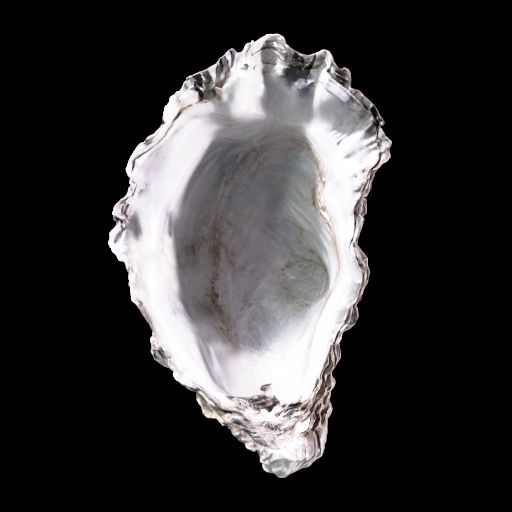
An empty oyster shell
The material the reef is built from: calcium carbonate, irregular and textured, already the surface a settling oyster larva looks for.
Drag to rotate, scroll or pinch to zoom.
Illustrative 3D model generated with Meshy AI from CCA concept artwork. Not a scan, an identified specimen or measured geometry.
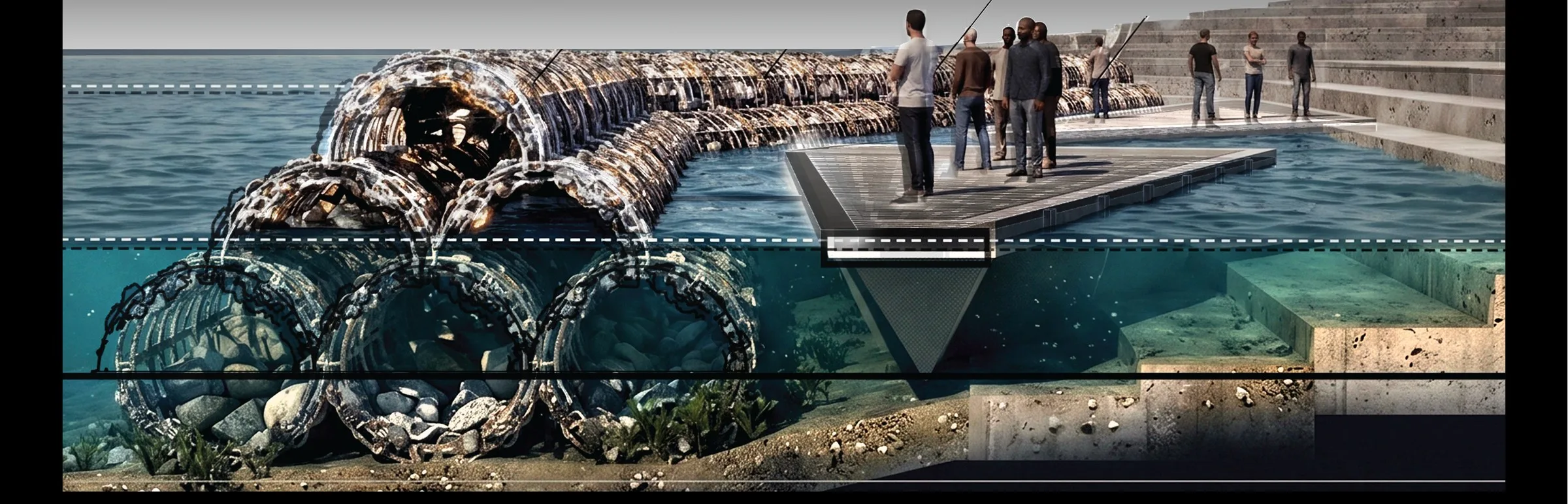
Fig. 01 Above and below the line. Shellfish reefs are well proven internationally for wave dissipation and biodiversity — but they have not been tested at large scale in the tropics, including Singapore. That is what SHIELD is for.
The species we want
Three we ask for first
SHIELD's reef modules are filled with biodegradable mesh bags of discarded shells — oysters, mussels and cockles — from local restaurants. Those three are the priority. Everything below that is welcome, but it gets sorted into its own pile.
Priority · 01
Oyster
Ostreidae — cupped, unequal valves
The most useful shell we handle. An oyster valve is thick, heavy, deeply cupped and ragged along its growing edge, and no two are the same shape. Piled together they never nest flat — they bridge and wedge, which is exactly what creates the voids and rough faces a reef bag needs. Oysters also grow on each other in the wild, so their shell is the surface their own larvae evolved to recognise.
Character
Thick, cupped, ragged edge, irregular outline
In a bag
Bridges and wedges; the best void-maker of the three
Priority · 02
Mussel
Mytilidae — elongated, thin-walled
Thinner and lighter than an oyster, with a long teardrop outline and a glossy inner nacre. Mussels are the packing material of a shell bag: their curved, elongated valves slot into the gaps oysters leave without filling them solid, adding a second, finer grade of texture. Small crabs and juvenile invertebrates use those narrower spaces.
Character
Elongated teardrop, thin wall, strongly curved
In a bag
Fine-grade texture between the larger valves
Priority · 03
Cockle
Cardiidae / Arcidae — ribbed, near-symmetrical
The ribbed one. Cockle valves are compact, rounded and carry deep radial ridges running from the hinge to the outer edge — a ready-made corrugated surface at a scale that suits very small animals. They are thick for their size and hold their shape well in a bag. Widely eaten here, which means a steady, reliable stream.
Character
Compact fan, deep radial ribs, sturdy for its size
In a bag
Corrugation at small scale; holds shape under load
Why oysters lead
One of the two test configurations is pure oyster
SHIELD will test two fills side by side: Biorock filled with oyster shells, and Biorock filled with mixed shells. Comparing them is part of the research — nobody has run that comparison at this scale in the tropics yet.
There is a good reason oysters get their own configuration. Oyster shells are resilient and tolerant of turbid, nutrient-rich waters, which makes them well suited to much of this region's coastal environments — warm, sediment-heavy, estuarine. A reef built for a tropical shoreline is sensibly built around the animal that already thrives on one.
Which fill performs better is an open question. SHIELD's own answer will come from monitoring after deployment.
Also welcome · sorted separately
Other bivalves we will happily take
If your kitchen produces these, don't throw them out. Keep them in a separate container from the oysters, mussels and cockles — sorting is a step in the workflow anyway, and separating at source saves a volunteer an hour later.
Second tier
Clam (lala)
Rounded, fairly smooth valves with fine concentric growth lines. Thinner than a cockle and more likely to nest flat against each other, so they work best mixed through a bag rather than filling one. Plentiful in local kitchens.
Note
Mix through; avoid filling a bag with these alone
Second tier
Razor clam
Long, straight, blade-like and brittle. Razor shells are the outlier in a bag — they lie parallel and can snap under load. Useful in small quantities as a spanning element between bulkier valves, which is why they are sorted apart rather than tipped in with everything else.
Note
Brittle; small quantities only, kept separate
Second tier
Scallop
The classic fluted fan. Broad, strongly ribbed and relatively flat, with a large surface area per shell. Excellent texture, but the flat profile means they stack like plates unless they are mixed with cupped valves. Good in a mixed-shell bag.
Note
Great texture, flat profile — mix, don't stack
Please don't send
What we can't take
None of this is fussiness. Every item below either breaks the cleaning method, fails as substrate, or works against the reason the project exists in the first place.
Meat or sauce left on
Mixed with food waste
Crab · prawn · lobster
Painted or varnished
Drilled or glued
Unknown source
Live shellfish
Beach-collected
NO 01
Shells still holding meat or heavy sauce
Residual flesh and rich sauces rot, attract pests and slow the drying stage badly — a shell that stays damp in the middle is a shell that never properly dries. Give them a quick scrape and a rinse before they go in the tub.
NO 02
Shells mixed into general food waste or cutlery
Lemon wedges, napkins, skewers, ice, teaspoons. Once shells are buried in a bin of general waste, recovering them costs more volunteer hours than the shells are worth. A separate container is the single most useful thing a kitchen can do.
NO 03
Crustacean shells — crab, prawn, lobster
A crab shell is not the same material as an oyster shell. Crustacean exoskeleton is built largely from chitin, a tough organic polymer, rather than the solid calcium carbonate structure the reef bags rely on. It is far softer, it degrades comparatively quickly in seawater, and it will not still be there in five years doing structural work. Delicious; wrong material.
NO 04
Painted, glued, varnished or drilled shells
Craft and décor shells carry coatings, adhesives and dyes we cannot identify and would rather not introduce to a marine environment. Drilled shells are usually decorative stock of unknown origin. Both are out.
NO 05
Shells from an unknown or non-food source
We need to be able to say where every shell came from. A traceable food-waste stream from a named kitchen is straightforward. A sack of shells of unclear origin is not, and we can't accept it.
NO 06
Live shellfish, wild-collected shellfish, or shells picked up from a beach
This is the important one, so here it is plainly. The entire purpose of Shellforce is to divert a waste stream — to catch shells that were already on their way to disposal and give them a second working life. Taking anything living from a shore does the opposite. And an empty shell lying on a beach or a mudflat is not litter: it is habitat. Something is living under it, on it, or inside it, and the sand around it is being built out of it. Removing beach shells to build a reef would mean dismantling one habitat to assemble another. Please leave the shore exactly as you found it. We want the ones from the kitchen.
The first question a biologist asks
The invasive species question
You are proposing to take shells out of a food supply chain — including shells that may have been farmed or landed somewhere else entirely — and put them into Singapore's marine environment. What stops you introducing an invasive species along with them?
The risk
Taken seriously, named openly
Introducing invasive species is one of the risks SHIELD identifies for itself, in writing, in its own proposal. It is not treated as a footnote. Any shell arriving from a commercial food chain is assumed to be carrying whatever it was carrying — spores, larvae, small hitchhikers — until it has been through the full process.
The mitigation
Fresh water, then weeks of sun
Every shell is cleaned with fresh water and then sun-dried for weeks. Not hours — weeks. The 2024 Witteveen+Bos pilot proved the method here: sufficient UV exposure from the sun naturally sterilises the surface of oyster shells, and marine species cannot survive that prolonged desiccation. The sterilisation is done by sunlight and time, not by chemicals that would then have to go into the sea.
Why this matters beyond the shells
It is worth being precise about what the pilot showed, because it is the reason this step is not negotiable. Singapore's first artificial oyster reef, piloted by Witteveen+Bos in 2023–2024 with bagged shellfish units, tested this cleaning method in local conditions. It worked. That is why the drying racks in the Shellforce workflow sit in full sun, why a batch sits for weeks rather than days, and why a volunteer shift spent turning shells is doing real biosecurity work, not busywork.
The short version. Every stage below has more detail behind it — the full sequence, including the staging area, the workboat and the anchoring, lives on the process page.
01
Restaurant
Shells are set aside from general waste at the kitchen — oysters, mussels, cockles.
02
Collection
Collected from local restaurants and brought in for processing.
03
Freshwater clean
Every shell is cleaned with fresh water. Residue off, salt off.
04
Weeks of sun-drying
Prolonged UV exposure and desiccation sterilise the shells. The slowest step, and the one that cannot be rushed.
05
Sorting
Shells are sorted — including into the pure-oyster and mixed-shell fills the project will test against each other.
06
Double-bagged in biopolymer mesh
Packed into biopolymer mesh bags and double-bagged — a lesson carried straight out of the 2024 pilot, where it reduced material ripping and lowered maintenance cost.
07
Into the steel cages
Pre-packed bags are placed into the modular steel cages once the network on site is secured.
08
Seabed, intertidal zone
Anchored in the intertidal zone — submerged at high tide, partly emerging at low tide. The site is to be confirmed by PUB.
The mesh bag is a temporary device. It is made of biopolymers and is designed to biodegrade after at least five years. Its only job is to hold loose shells together at the moment of deployment — and by the time it gives way, it is not needed, because biological growth has cemented the individual shells to one another. The bag disappears. The reef stays. What you handed over stops being a bag of shells and becomes one continuous, living structure.
Then live shellfish move in of their own accord. In the 2024 pilot, spat recruitment — young shellfish settling onto the substrate — was observed on nearly half of the shells, and species richness tripled. Your shell is not a memorial. It is a landing pad.
49%of shells showed spat recruitment in the 2024 Witteveen+Bos pilot
3×species richness tripled in the same pilot
5 yearsminimum design life of the biopolymer mesh bag before it biodegrades
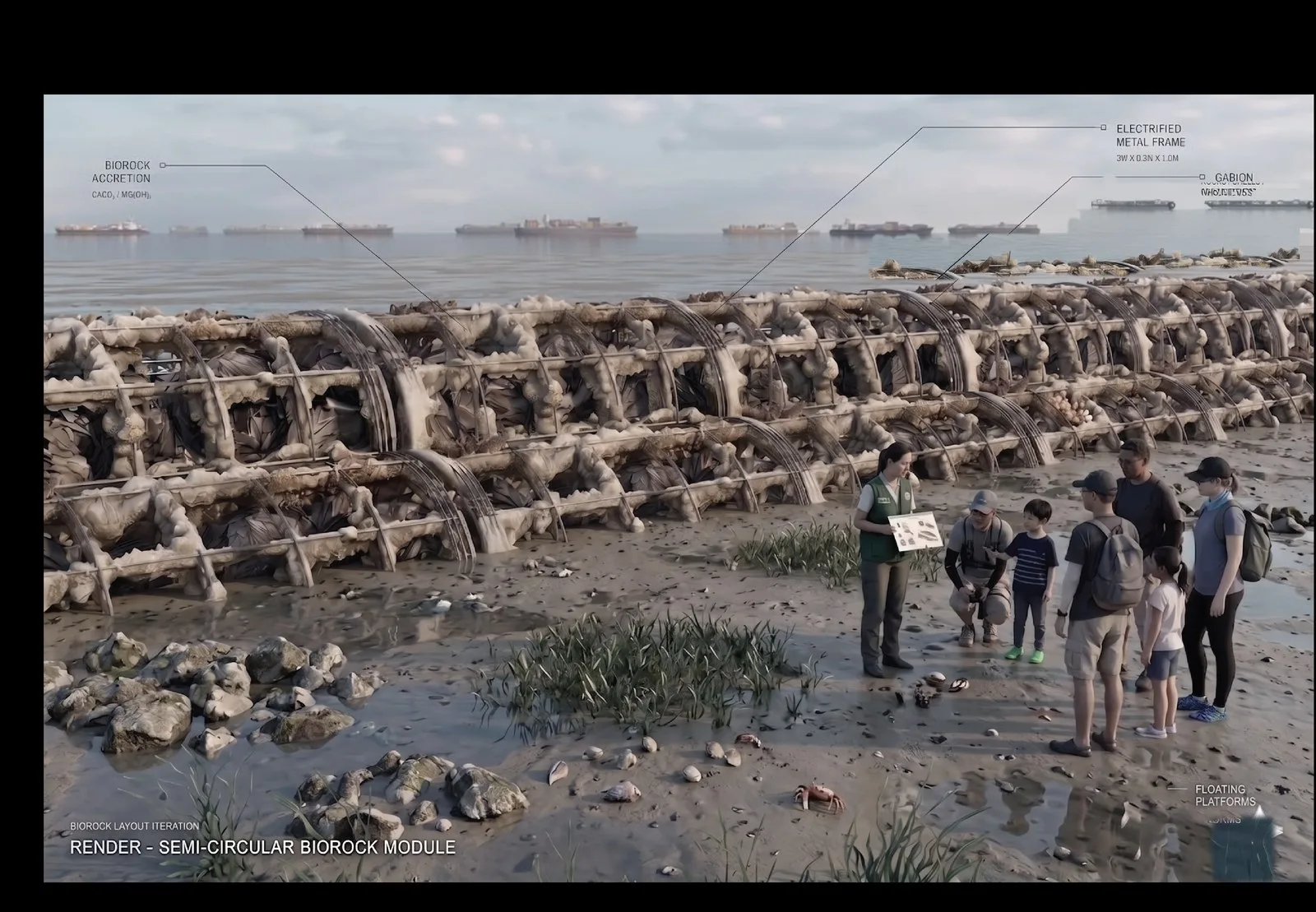
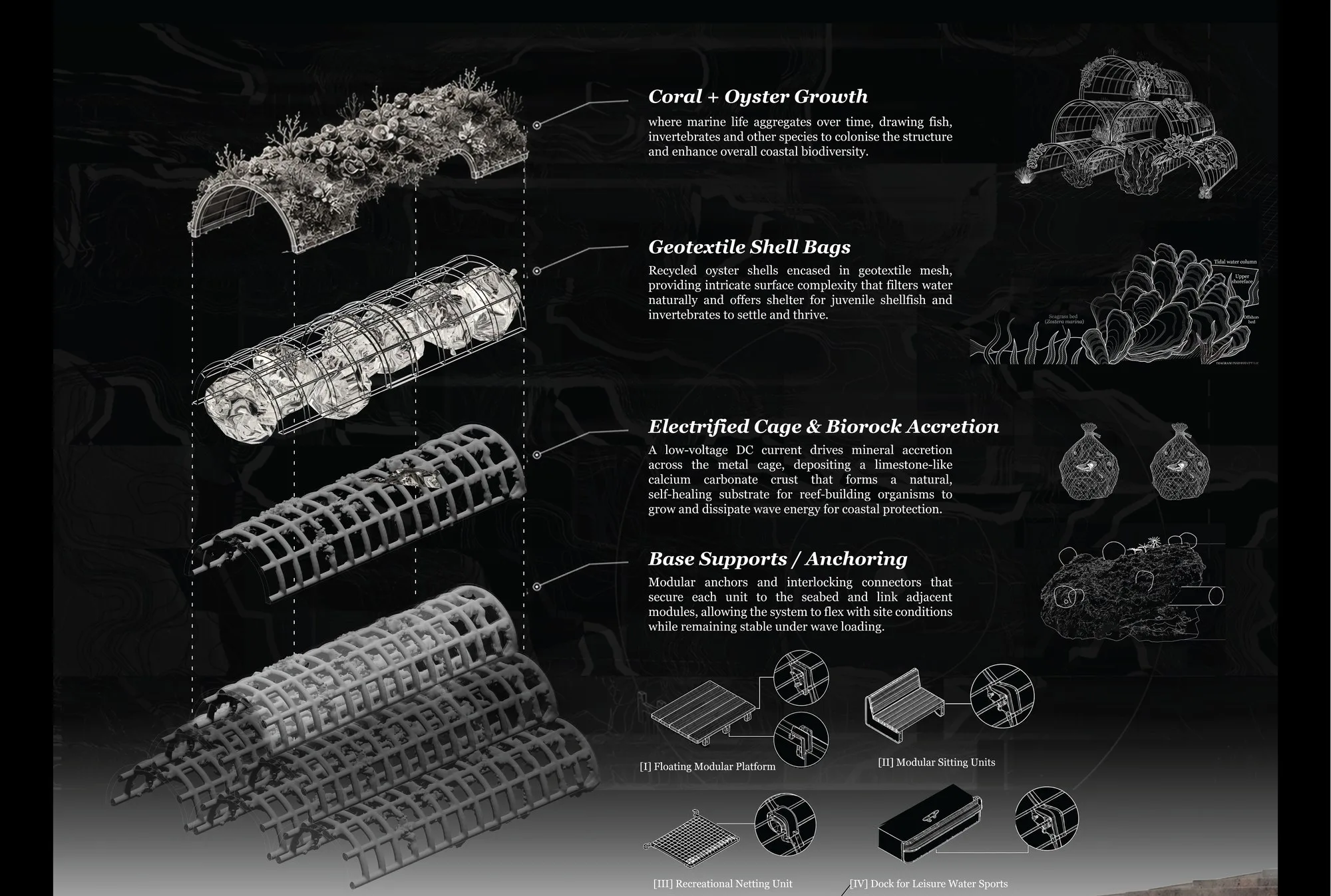
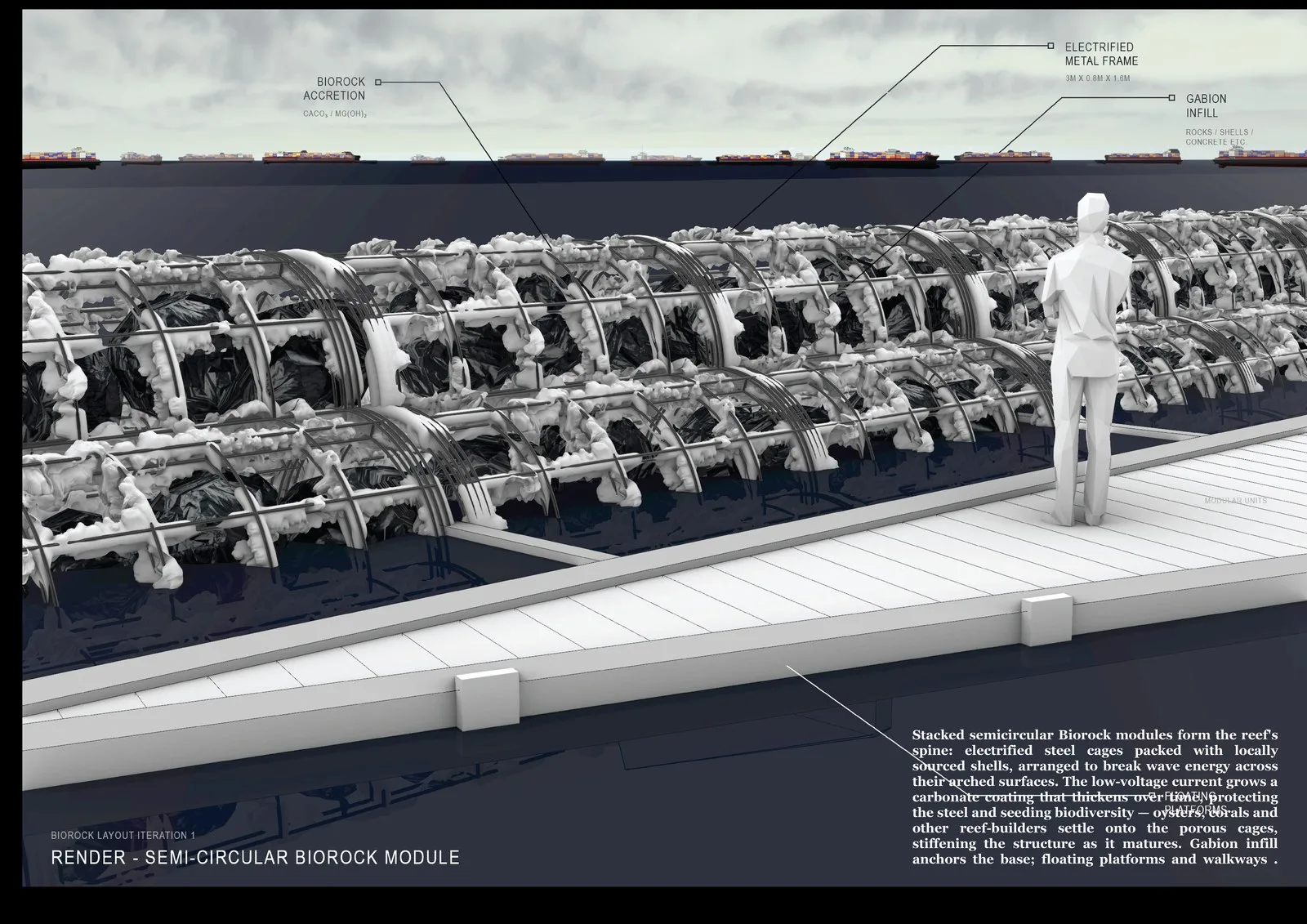
Fig. 02 At low tide the reef partly emerges and can be walked to and looked at. The shells you can see are the ones doing the work.Fig. 03 Where the bags sit. Shell bags fill the electrified steel cage; the biorock coating grows on the steel around them.
For restaurants
If you run a kitchen in Singapore
SHIELD's reef is filled with discarded shells from local restaurants. That means the supply is not an abstraction — it is a set of real kitchens deciding to put their shells in a different container. If yours is one of them, the practical shape of a partnership looks like this.
Every arrangement is worked out case by case with the individual partner. We are not going to pretend there is a standard bin size or a fixed pickup day, because those are agreed with you, around your service hours and your storage.
You do Keep oyster, mussel and cockle shells out of the general waste stream — a separate lidded container beside the wash-up point is usually enough.
You do Scrape off leftover meat and heavy sauce, and give the shells a quick rinse.
You do Keep clams, razor clams and scallops in a second container if you have them.
We do Agree a collection arrangement with you directly, then take the shells away for cleaning, drying, sorting and bagging.
We do Handle every step of the biosecurity process — the freshwater clean and the weeks of sun-drying happen on our side, not yours.
Cost No charge from us for taking a stream you currently pay to have disposed of. What you are diverting is waste; what we are collecting is material.
To confirm Collection frequency, container specifics and volumes are arranged with each partner. The number of participating restaurants is still being established.
The proposal commits to engaging local organisations in preparation works, and names collecting and processing shellfish material from restaurants as a planned activity. This is that activity.
Fig. 04 Indicative reef modules with a public walkway. A "kit of parts" of attachments — platforms, fish pans, small piers, floating gardens — can be added so the structure makes public place, not just defence.
The full workflow: collection, freshwater cleaning, weeks of sun-drying, sorting, double-bagging, the staging area, the workboat, and installation on site.
Modular steel cages, biorock electrification and its limestone mineral coating, anchoring, the intertidal placement, and the two fill configurations being tested.
Cleaning, turning and bagging shells is hands-on work that local volunteers can do. Session dates are still to be confirmed — this is how to be told when they are.
Talk to a person
Questions about a specific shell?
If you are unsure whether something in your kitchen is useful to us, ask. A short email with a photo settles it faster than a rule ever will.