Move 01
Collect
Oyster, mussel and cockle shells are gathered from local restaurants. Not scavenged from a beach — diverted from a waste stream that would otherwise go to landfill.
 Back to Home
Singapore Living Lab · Coastal Protection
Shellforce collects discarded oyster, mussel and cockle shells from Singapore's restaurants — cleans them, dries them in the sun, bags them — and packs them into steel cages that will become a living breakwater on our own shore.
The situation
Roughly 70% of Singapore's coastline is guarded by hard engineered structures — revetments and seawalls. They work. That is not in question.
But they generally serve a single function. They are less biodiverse than the shores they replaced, and they sit awkwardly against the way people actually use the water's edge. Meanwhile sea level is rising, storm surges are becoming more frequent, and waves are expected to carry more energy.
The obvious answer — build harder, build wider — costs the one thing this island does not have. Singapore's dense urban coastline offers very little spare land or sea space. So the question becomes: can a coastal defence do more than one job at once?
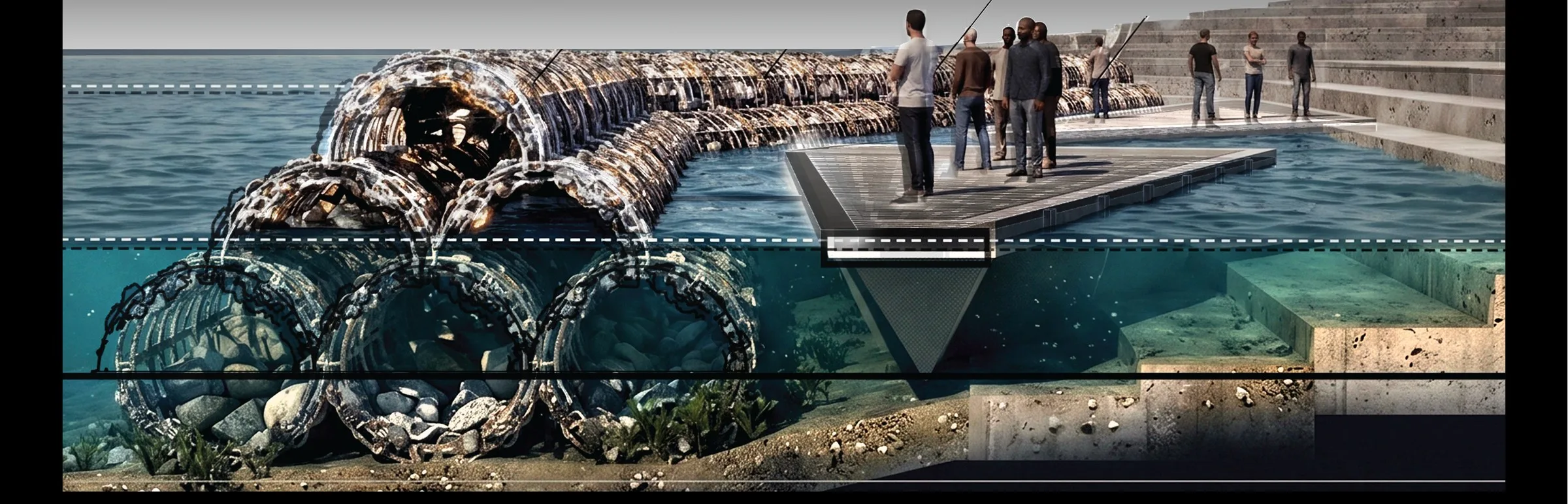
“A reef that breaks waves, builds habitat and makes a place worth standing in.”
SHIELD integrates shellfish reefs with three ecosystem services at once — coastal protection, nature enhancement and landscape urbanism.
What Shellforce does
Move 01
Oyster, mussel and cockle shells are gathered from local restaurants. Not scavenged from a beach — diverted from a waste stream that would otherwise go to landfill.
Move 02
Every shell is washed in fresh water, then laid out to dry in the sun for weeks. The UV sterilises the surface and nothing marine survives that long a desiccation. Then they are sorted and double-bagged in biopolymer mesh.
Move 03
The bags are packed into modular steel cages, anchored on the seabed in the intertidal zone and gently electrified — so limestone grows over the steel and marine life moves in.
The full process Which shells we want
Anatomy
This is the module, built to the proposal's indicative dimensions.
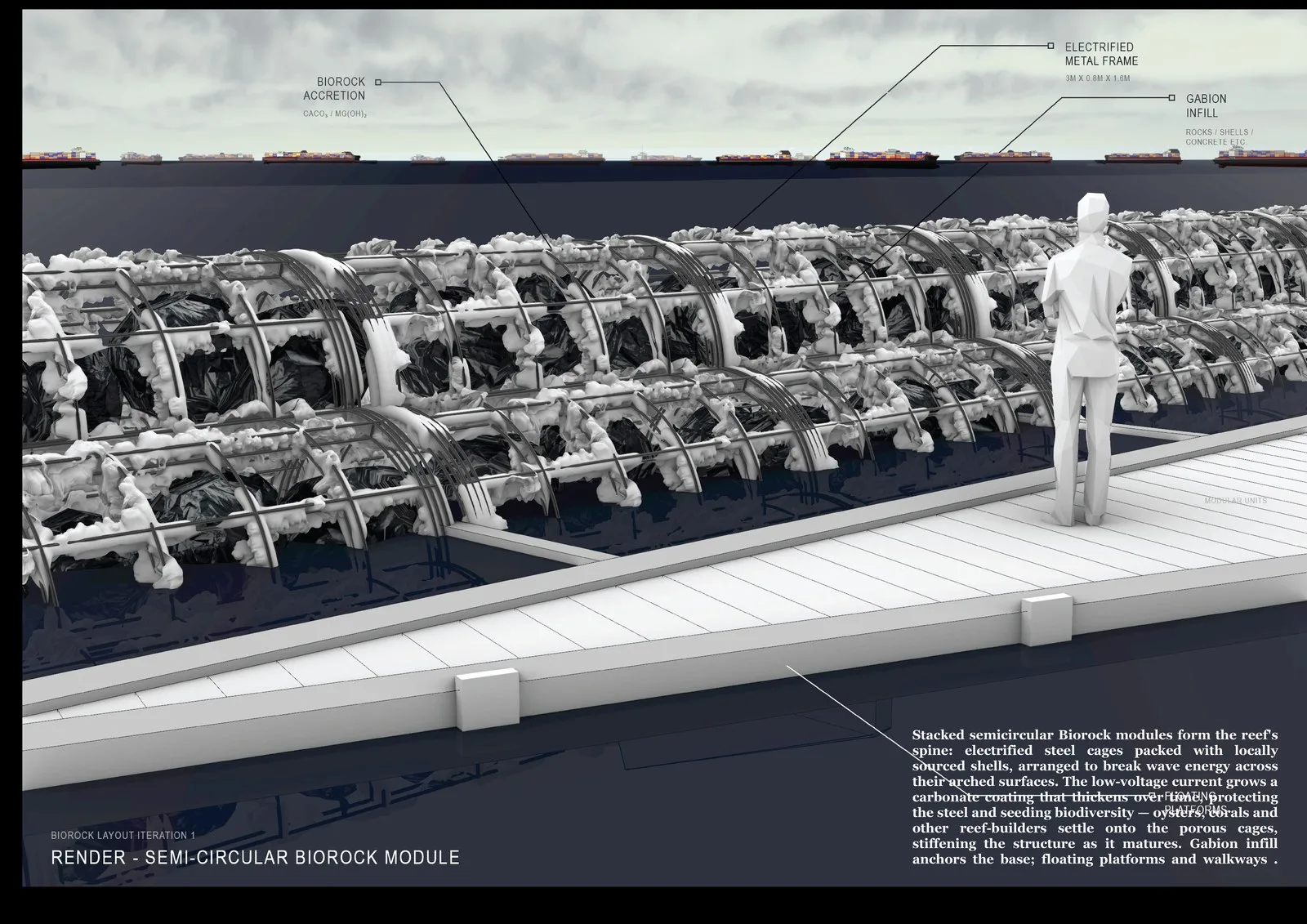
A modular steel cage, filled with biodegradable mesh bags of discarded shells. Low-voltage direct current runs through the steel, and the electrolysis of seawater grows a limestone coating across it — a process called Biorock.
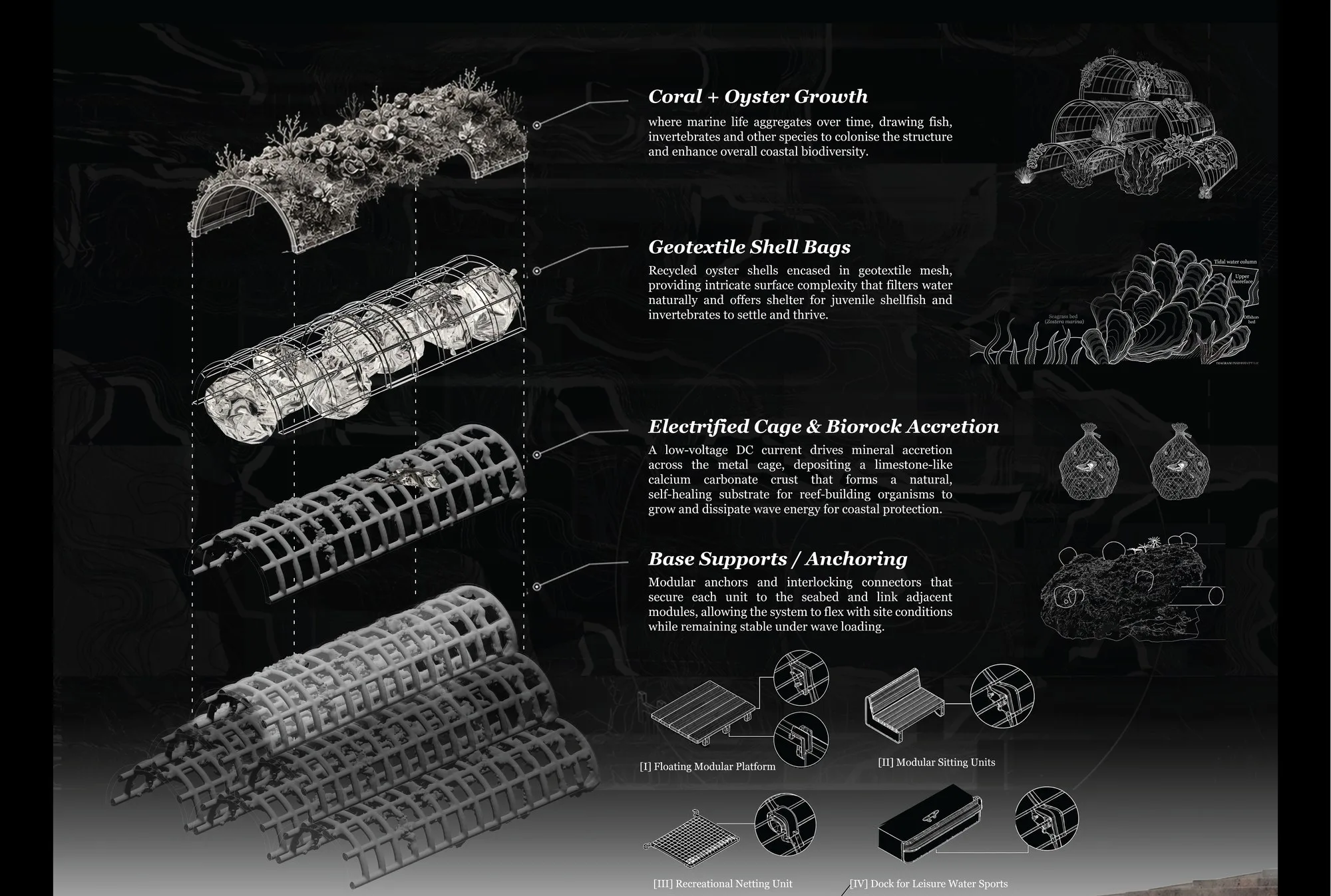
Fig. 01 Exploded axonometric of one reef module, from the SHIELD research. Shown at the proposal's indicative dimensions — roughly 2 m wide and up to 1 m high, here as a 3 m length of the reef line. Dimensions will be refined; this is a diagram, not a construction drawing.
Layer 01
Your shells, double-bagged in biopolymer mesh. The bags biodegrade after at least five years — by then biology has cemented the shells to each other and the mesh has no job left.
Layer 02
The limestone coating stops the steel rusting, makes the structure stronger over time instead of weaker, and speeds up the growth of shellfish on the surface. Power comes from one or two solar panels on the shore.
Layer 03
Screw-type helical anchors or steel bar pins, with concrete ballast blocks at the junctions that scouring would attack first. It sits in the intertidal zone — underwater at high tide, part-exposed at low.
Specimens
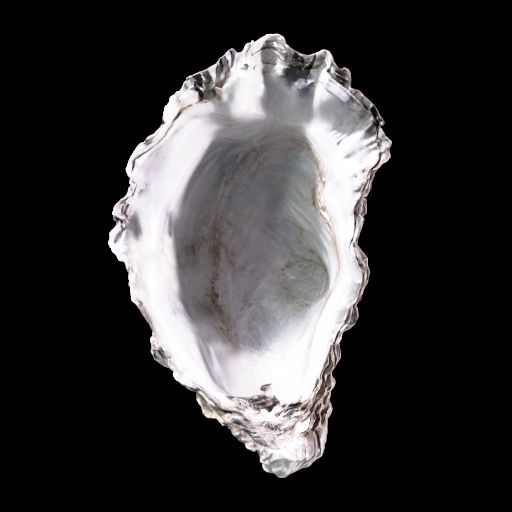
The material the reef is built from: calcium carbonate, irregular and textured, already the surface a settling oyster larva looks for.
Drag to rotate, scroll or pinch to zoom.
Illustrative 3D model generated with Meshy AI from CCA concept artwork. Not a scan, an identified specimen or measured geometry.
Already proven here
Witteveen+Bos built Singapore's first artificial oyster reef in 2023–24, using bagged shellfish units. SHIELD is what comes next, at a bigger scale.
These are aspirational targets that guide the project and inform decision-making — not binding commitments. Real-world results vary with site conditions, coastal variability and maintenance realities.
What it could become
The modules take a kit of parts — floating platforms, small piers, fish pans, floating gardens. The protection is the substrate; the place is the point.
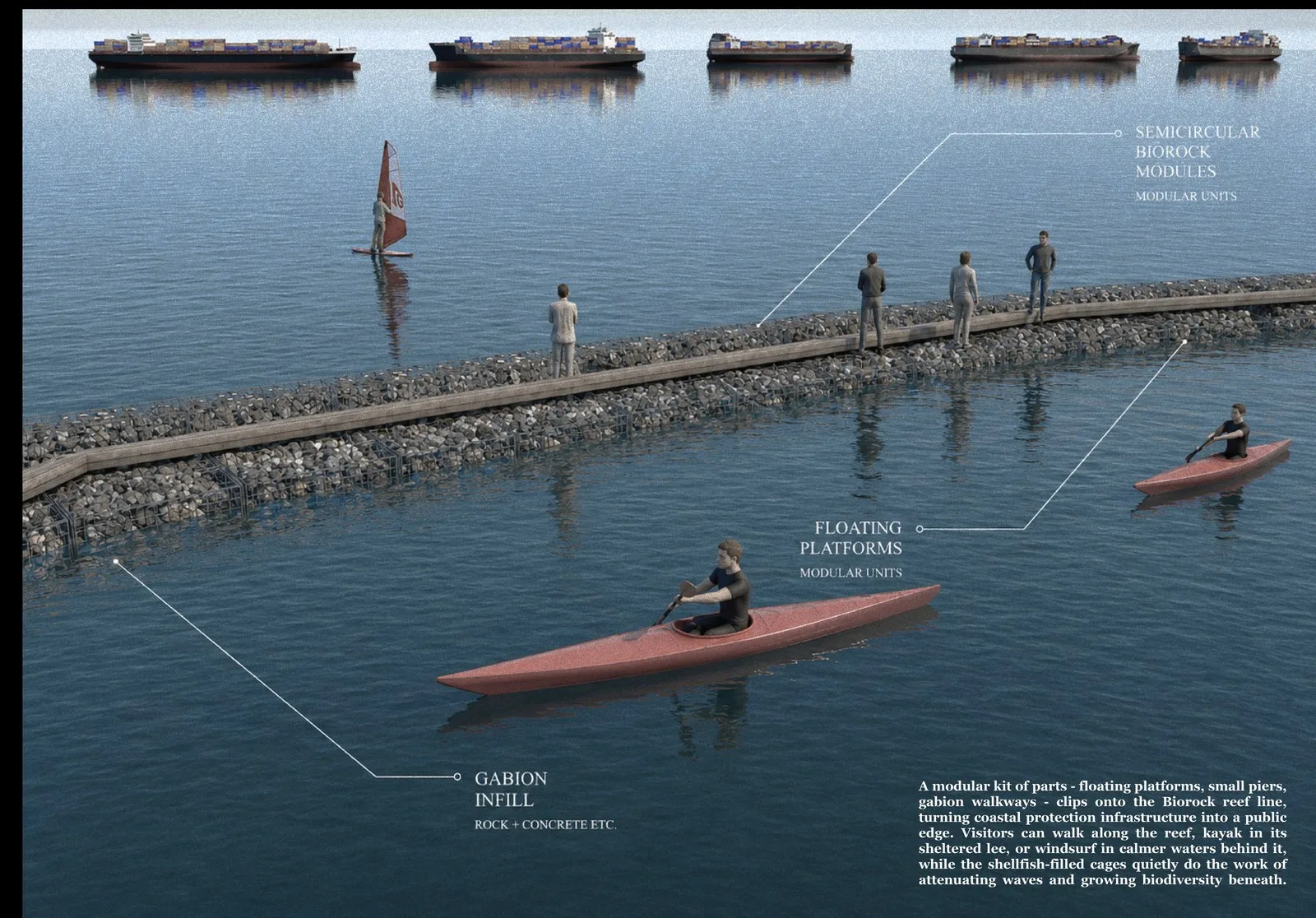
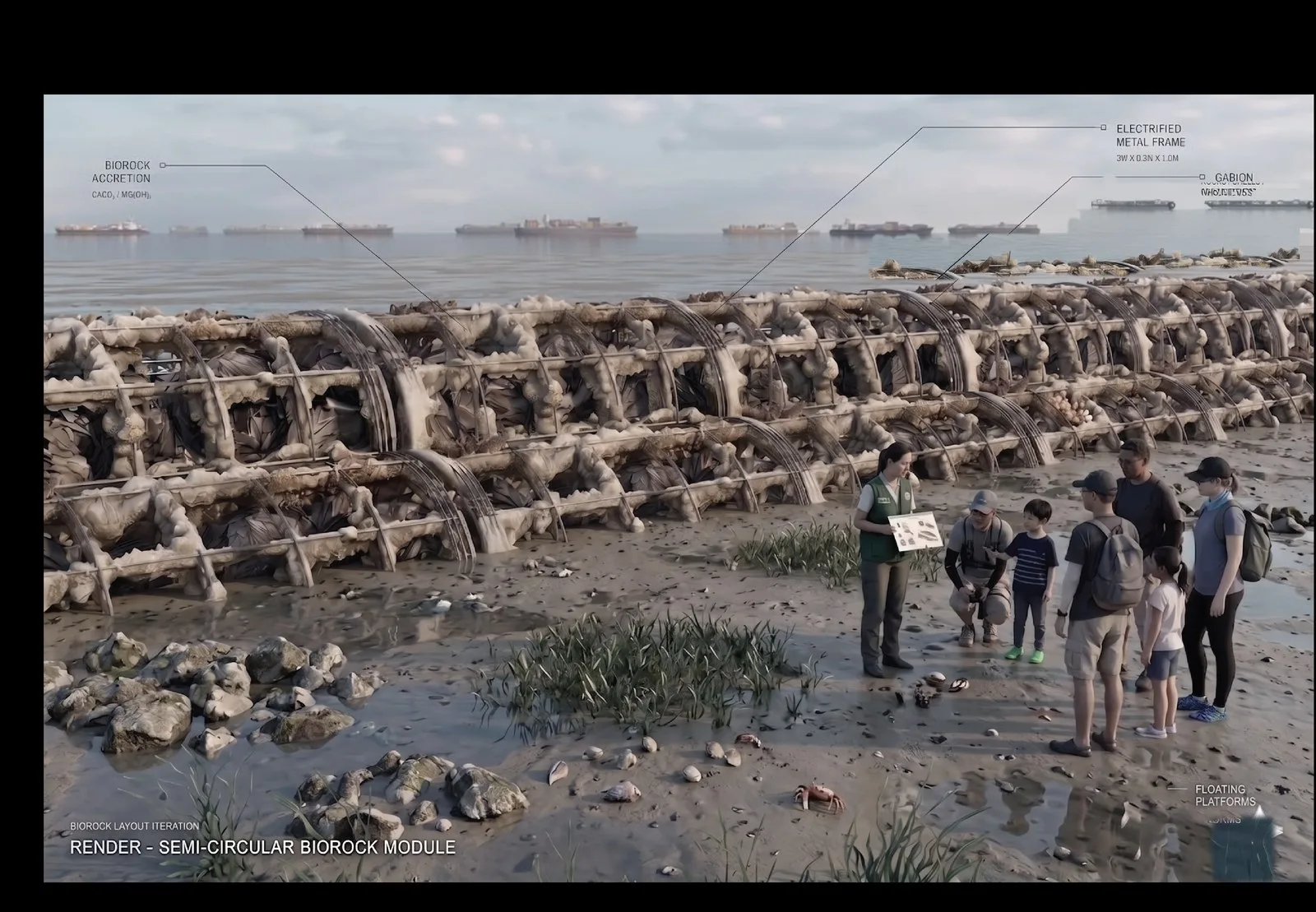
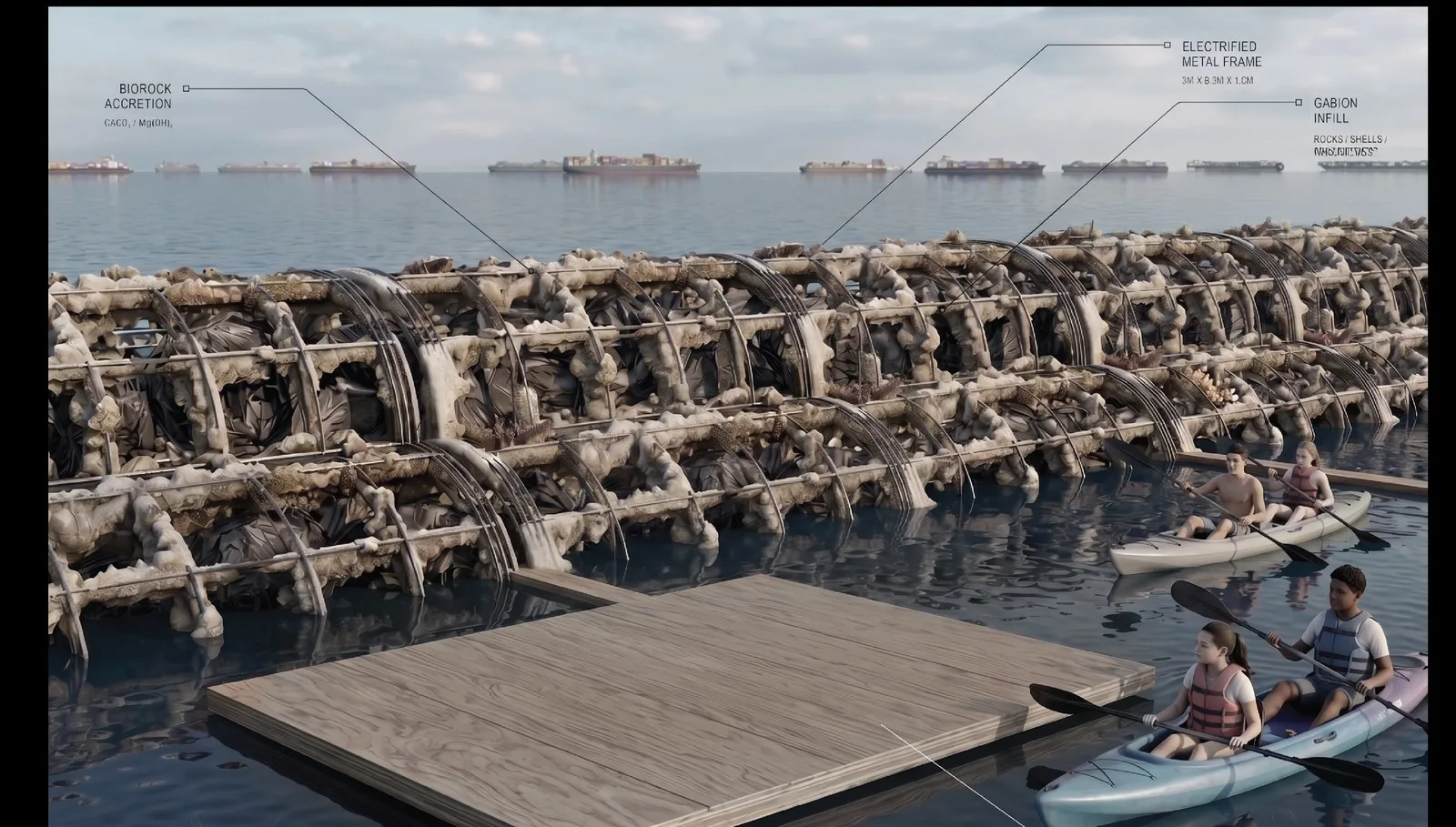
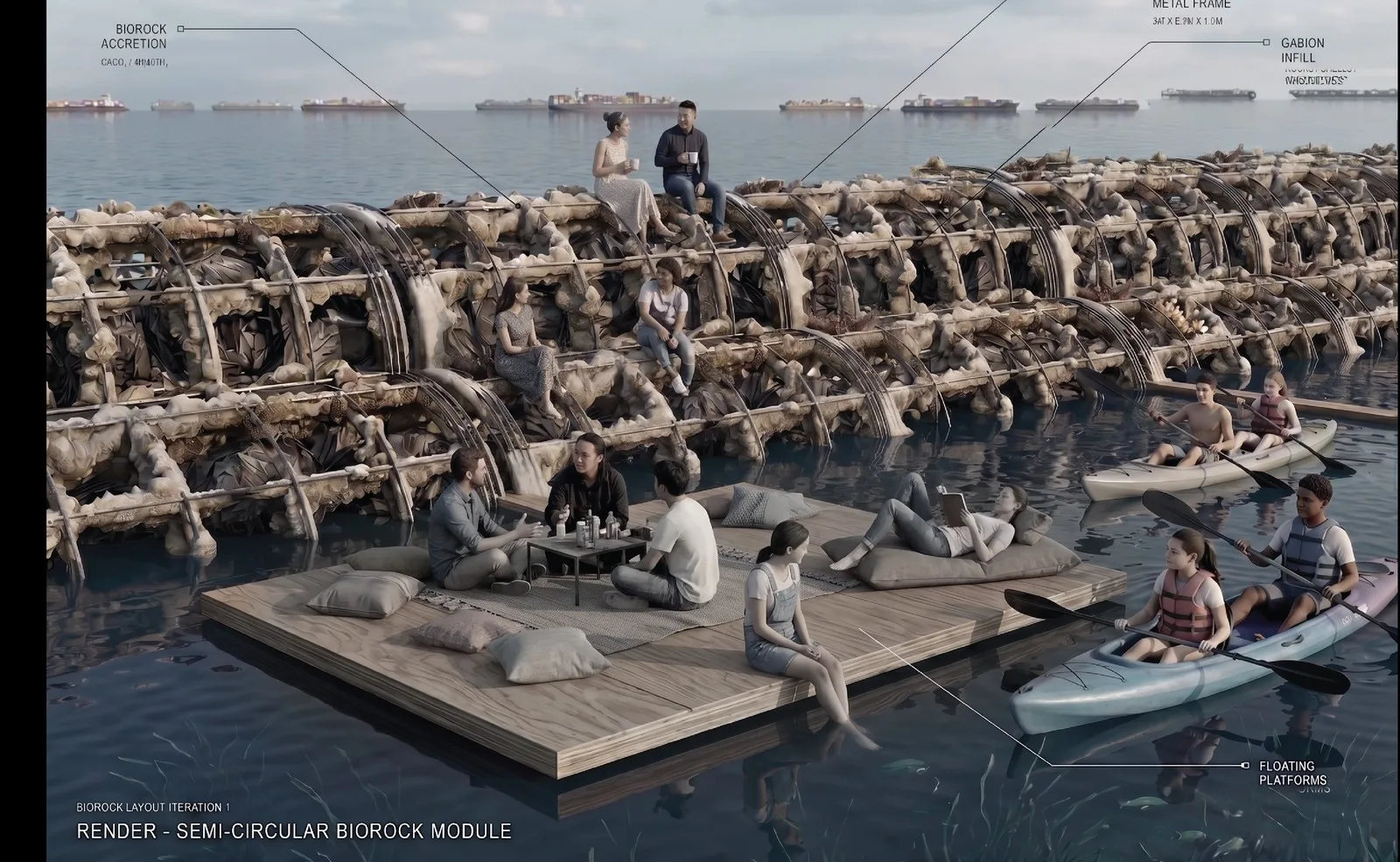
Renders and drawings from the SHIELD Living Lab research. The shoreline assumed in the proposal is NSRCC beach on the East Coast; the final site is to be confirmed by PUB.
Why bother
Singapore's Zero Waste Masterplan and the Sustainable Living pillar of the Green Plan 2030 aim to cut waste sent to landfill by 30% by 2030. A restaurant's shell bucket is about as literal a case of circularity as you will find: a material that is already calcium carbonate, already the right shape, already exactly what a settling oyster larva is looking for.
SHIELD also answers the Resilient Future pillar — nature-based enhancements that adapt to sea-level rise — and the Integrated Coastal Management thread of Singapore's National Biodiversity Strategy and Action Plan.
And because it is low-tech, it travels. Simple materials, locally available shellfish waste, a low barrier to entry: the same system could be assembled by coastal communities across Southeast Asia, where shoreline erosion is an urgent and under-resourced problem.
Who is behind it
SHIELD is hosted by the Singapore University of Technology and Design, led by Prof. Eva Castro, director of the Centre for Climate Adaptation. It is delivered with Mlion Corporation, with ecological validation and hydrodynamic modelling by Witteveen+Bos South-East Asia and construction support from HSL Constructor — funded by PUB on behalf of the National Research Foundation under the Coastal Protection and Flood Management Research Programme (Living Lab).
Spread it
We do not need money and we are not selling anything. We need shells, and shells live in other people's kitchens. The single most useful thing you can do in the next sixty seconds is forward this page to someone who throws oyster shells away.
Tag it #shellforce if you post it anywhere.
Ask 01 · a restaurant
“Hi — do you throw out your oyster and mussel shells? There's a coastal protection project at SUTD collecting them to build a reef on the East Coast. Would you be up for saving a bucket?”
Ask 02 · a school or lab
Washing and sorting shells is a genuinely good field session — circular economy, intertidal ecology and coastal engineering in one afternoon, with a real structure at the end of it.
Come and help
If you care about the ocean and you can spare a morning, there is a real job for you. Collecting shells. Washing them. Laying them out in the sun. Filling mesh bags. It is the least glamorous part of a coastal engineering project and it is completely indispensable.
Session dates and the staging location are still being arranged. Email us and we will tell you the moment shifts open.