Shellfish Habitats for Integrated EcoLogical Defence.
An engineered shellfish reef built for a tropical coast, designed to do three jobs at once: break waves, build habitat, and make a place people actually want to be.
Living Lab CFRP-LL01-0004
1 May 2026 – 30 Apr 2029
TRL 5 → TRL 7
Three jobs, one structure
Most sea walls only do one thing.
About 70% of Singapore's coastline is guarded by "hard" structures — engineered revetments and seawalls. They work. But they usually serve a single function: coastal protection. They tend to be less biodiverse than the shores they replaced, and they are poorly integrated with the way people actually use the water's edge.
SHIELD is an attempt to get all three returns from the same footprint — which matters in a city with very little spare land or sea space to give away.
Job 01
Coastal protection
A rough, porous, living structure sitting in the shallows takes energy out of incoming waves before they reach the beach. Slower water drops what it carries, so sedimentation increases behind the reef instead of sand being drawn away from it.
Job 02
Biodiversity
Shell is a surface marine life recognises. The reef gives juvenile shellfish, invertebrates and fish somewhere to settle, shelter and feed — turning a stretch of defended shoreline back into habitat rather than a blank wall.
Job 03
Public place
The geometry is designed to carry attachments — platforms, piers, gardens — so the structure reads as landscape, not infrastructure. People can walk it, paddle beside it and watch it change. Defence that is also somewhere to be.
Anatomy of a module
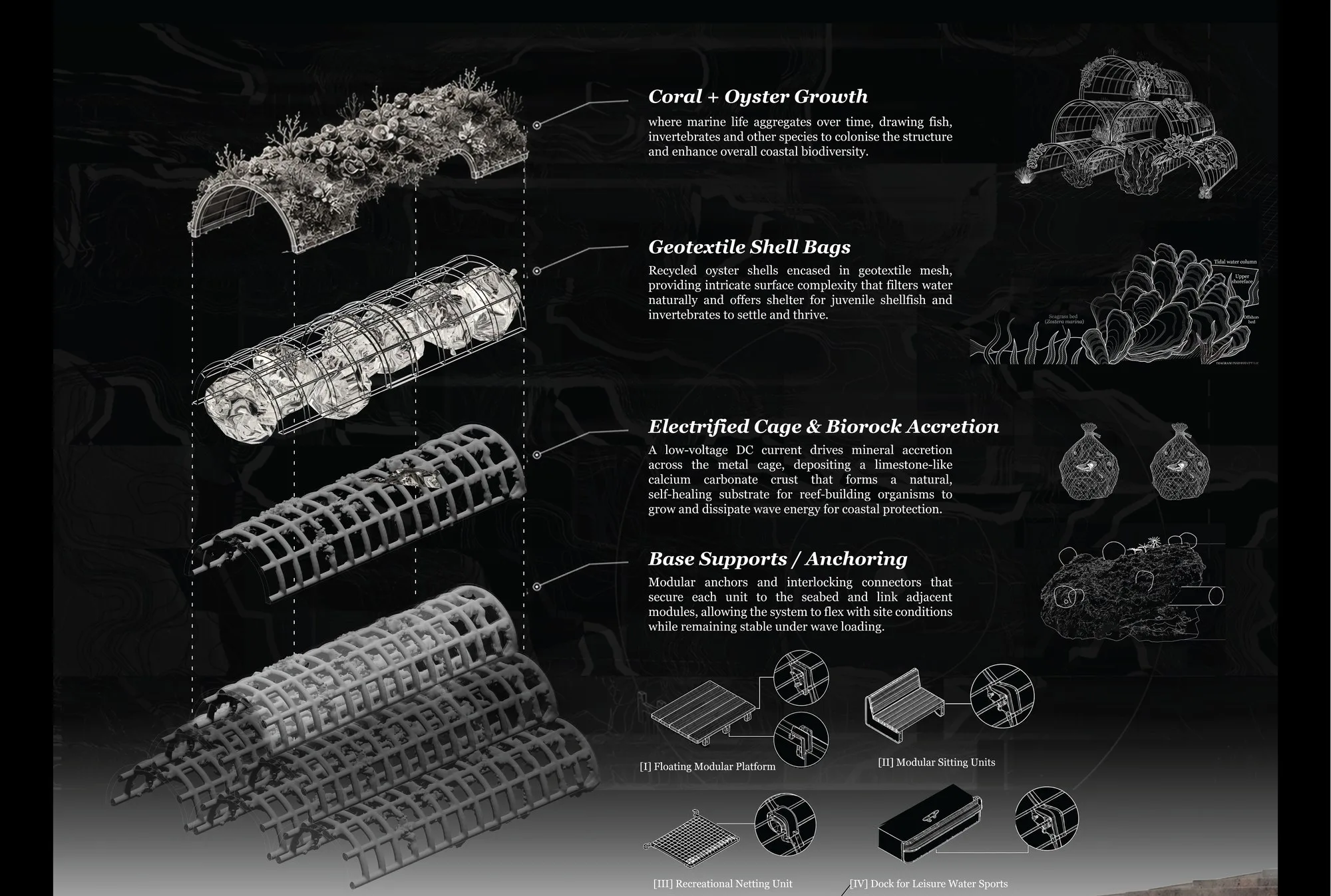
Four layers, stacked from the seabed up.
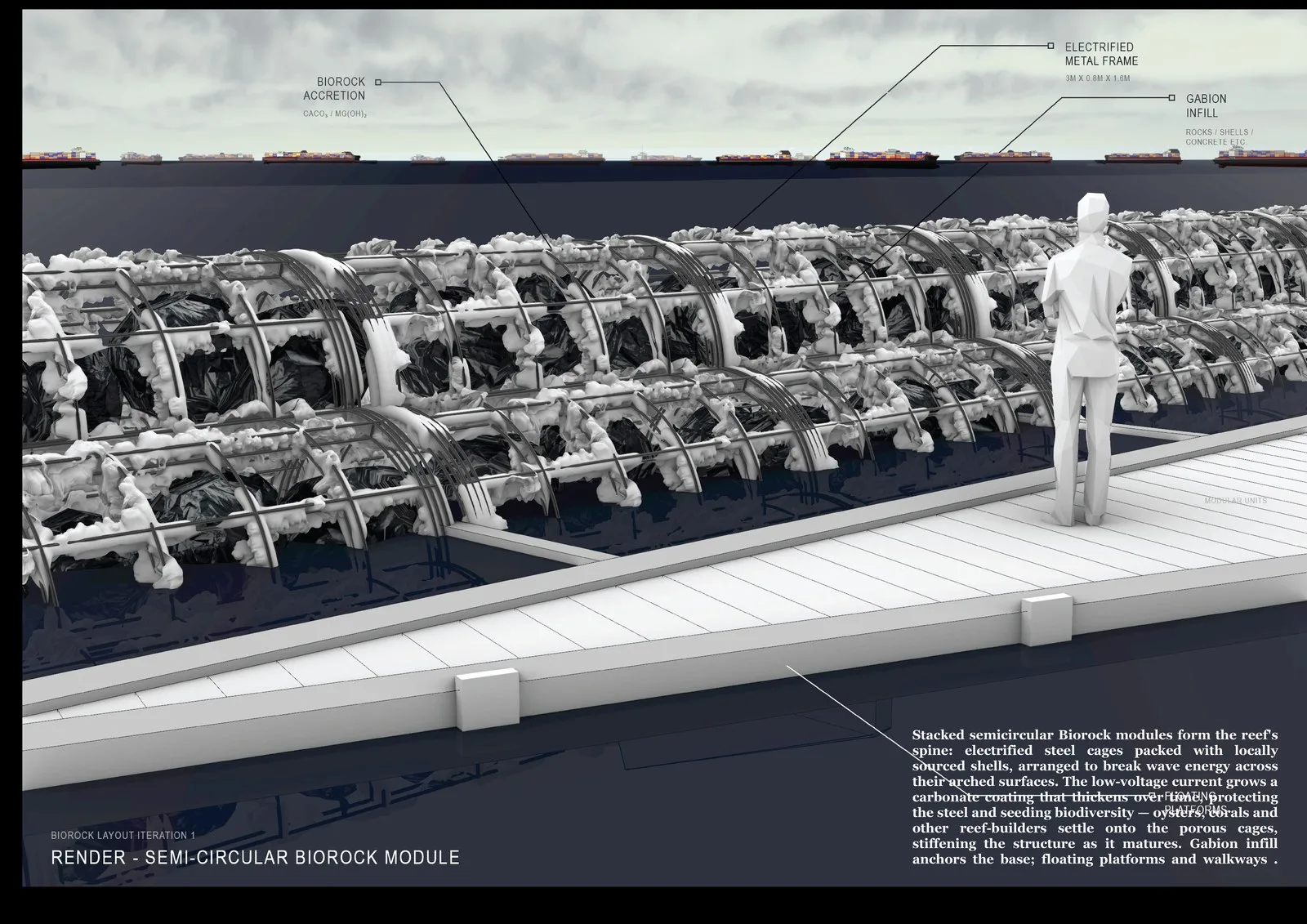
The reef is not one object. It is a repeated module — a steel cage packed with bagged shell, anchored to the seabed and quietly electrified. Each layer does a different job, and the biology is expected to take over from the engineering with time.
Fig. 01 Exploded axonometric of a single SHIELD module, as drawn for the Living Lab proposal. Dimensions on this page are indicative and will be refined.
Indicative dimensions
Reef structure about 50 m long. Each module about 2 m wide and up to 1 m high. These are the numbers assumed in the proposal — indicative, and to be refined as the detailed design develops.
Layer 01
Coral + oyster growth
Marine life aggregates over time, drawing fish and other species, colonising the structure and enhancing coastal biodiversity. This is the layer nobody builds — it arrives on its own if the rest of the module is right.
Layer 02
Geotextile shell bags
Recycled oyster shells encased in biopolymer mesh, providing intricate surface complexity that filters water naturally and offers shelter for juvenile shellfish and invertebrates to settle and thrive.
The bags are biopolymer and designed to biodegrade after at least five years, and they are double-bagged — a lesson carried over from the 2024 pilot, where double-bagging reduced ripping and maintenance. Their only job is to hold loose shells together until biology cements them to each other.
Layer 03
Electrified cage & Biorock accretion
A low-voltage DC current drives mineral accretion across the steel, depositing a limestone-like calcium carbonate crust that forms a natural, self-healing substrate for reef-building organisms to grow on and dissipate wave energy for coastal protection.
Layer 04
Base supports & anchoring
Modular anchors and interlocking connectors secure each unit to the seabed and link adjacent modules, allowing the system to flex with site conditions while remaining stable under wave loading.
In practice this means screw-type helical anchors or reinforcing steel bar pins, with concrete U-shaped ballast blocks pinned at critical junctions to resist scouring.
The mineral layer
What Biorock actually is.
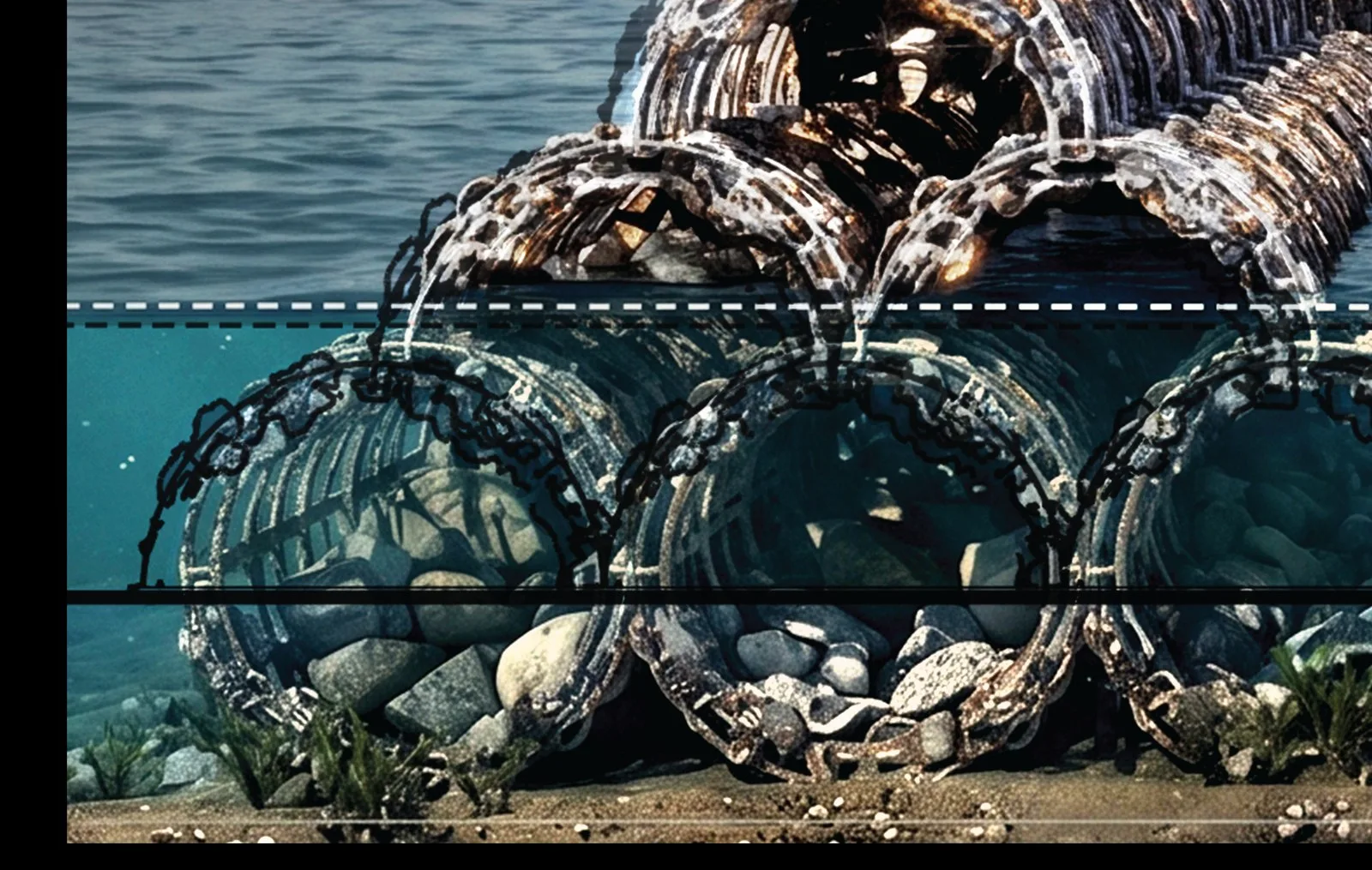
Fig. 02 Shell-packed cages at the waterline. The steel is the electrode; the shell is the surface; the mineral crust grows across both.
Run a safe, low-voltage current through submerged steel and seawater does something useful. Electrolysis pulls dissolved minerals out of the water and deposits them onto the steel as a limestone coating. The structure does not corrode away — it thickens.
It stops the rust
The mineral coating protects the steel instead of letting seawater eat it, so the structure gets stronger over time rather than weaker.
It speeds up life
Electrification accelerates the growth of marine organisms on the structure (Goreau, 2014) — the reef establishes faster than it would on bare substrate.
It lowers a known risk
It reduces the risk of cyanobacteria blooms associated with untreated steel sitting in seawater.
It runs on sunlight
Power comes from one or two solar panels mounted nearby. No grid connection, no fuel, no moving parts in the water.
Why this is new
Biorock has mostly been used for coral restoration. SHIELD is the first of its kind to integrate it with coastal protection — using the mineral accretion not only to grow reef, but to build a structure that has to stand up to waves.
Living in the tide
Underwater twice a day, in the air twice a day.
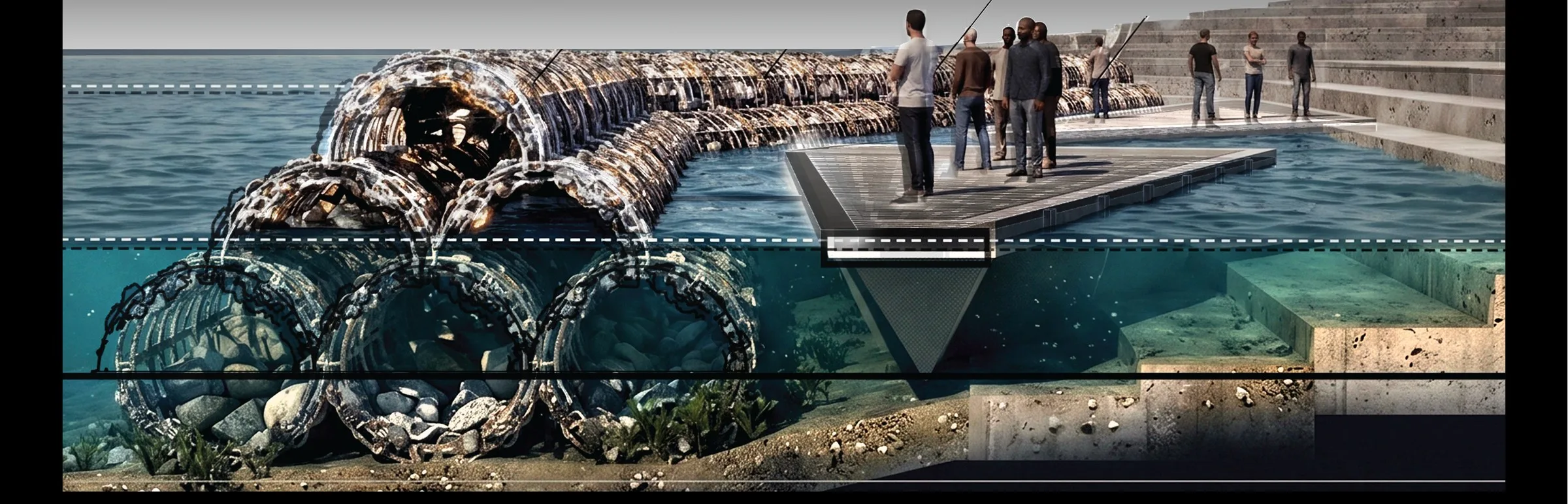
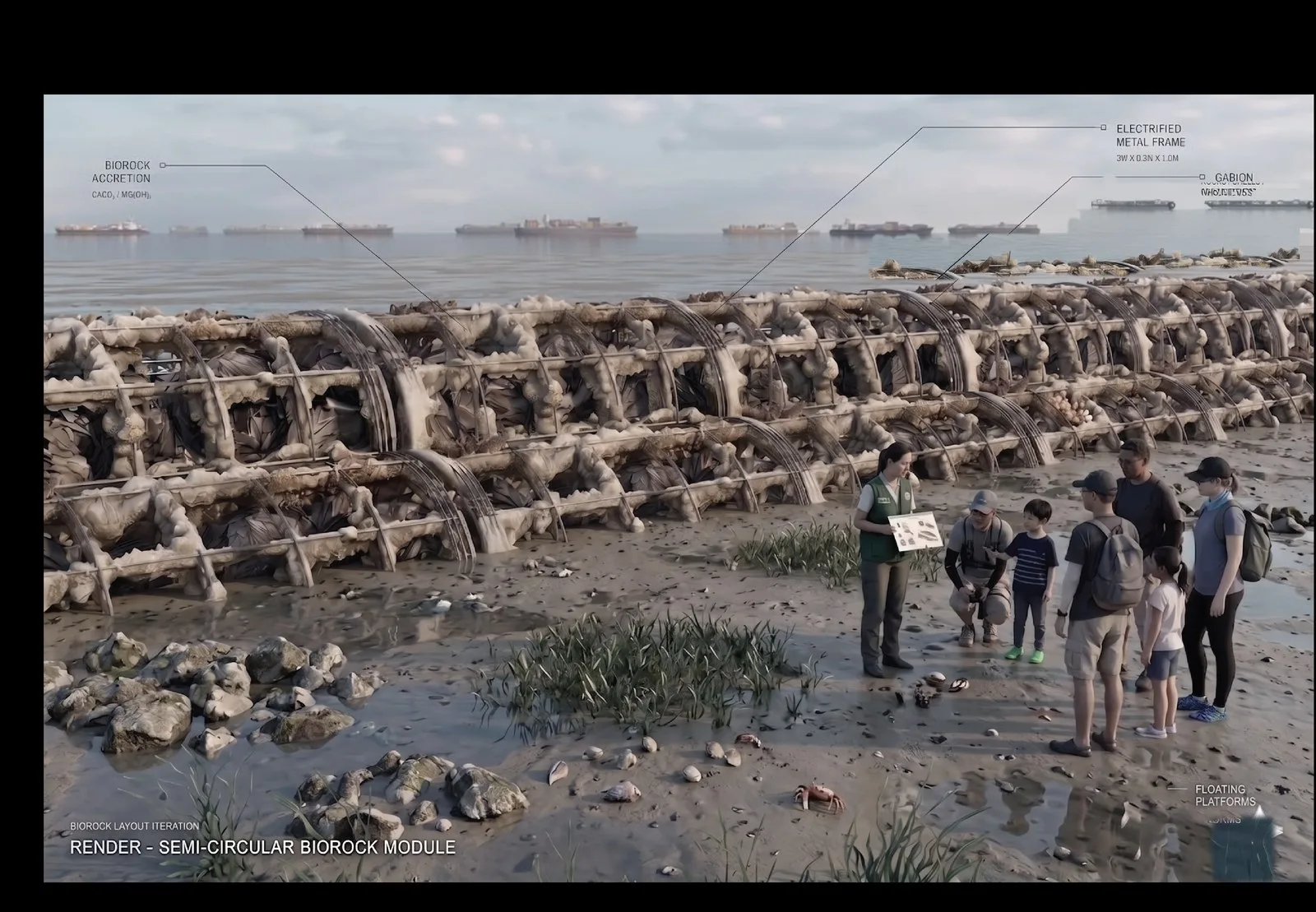
The reef sits in the intertidal zone. At high tide it is submerged. At low tide it partly emerges — and that rhythm is the point. Alternating immersion and exposure is what encourages shellfish growth, so the position of the structure in the tidal range is a design decision, not an accident of depth.
It also means the reef is legible. Twice a day, the thing doing the work is visible from the beach.
Two configurations under test
Config A
Biorock filled with oyster shells
A single-species fill. Oyster shell only, packed into the bagged cages, electrified as normal.
Config B
Biorock filled with mixed shells
A mixed fill — the oysters, mussels and cockles that actually come back from restaurant kitchens.
The two configurations are placed far enough apart that they do not interact, so the monitoring can tell which fill is doing what.
A kit of parts
Defence you can stand on.
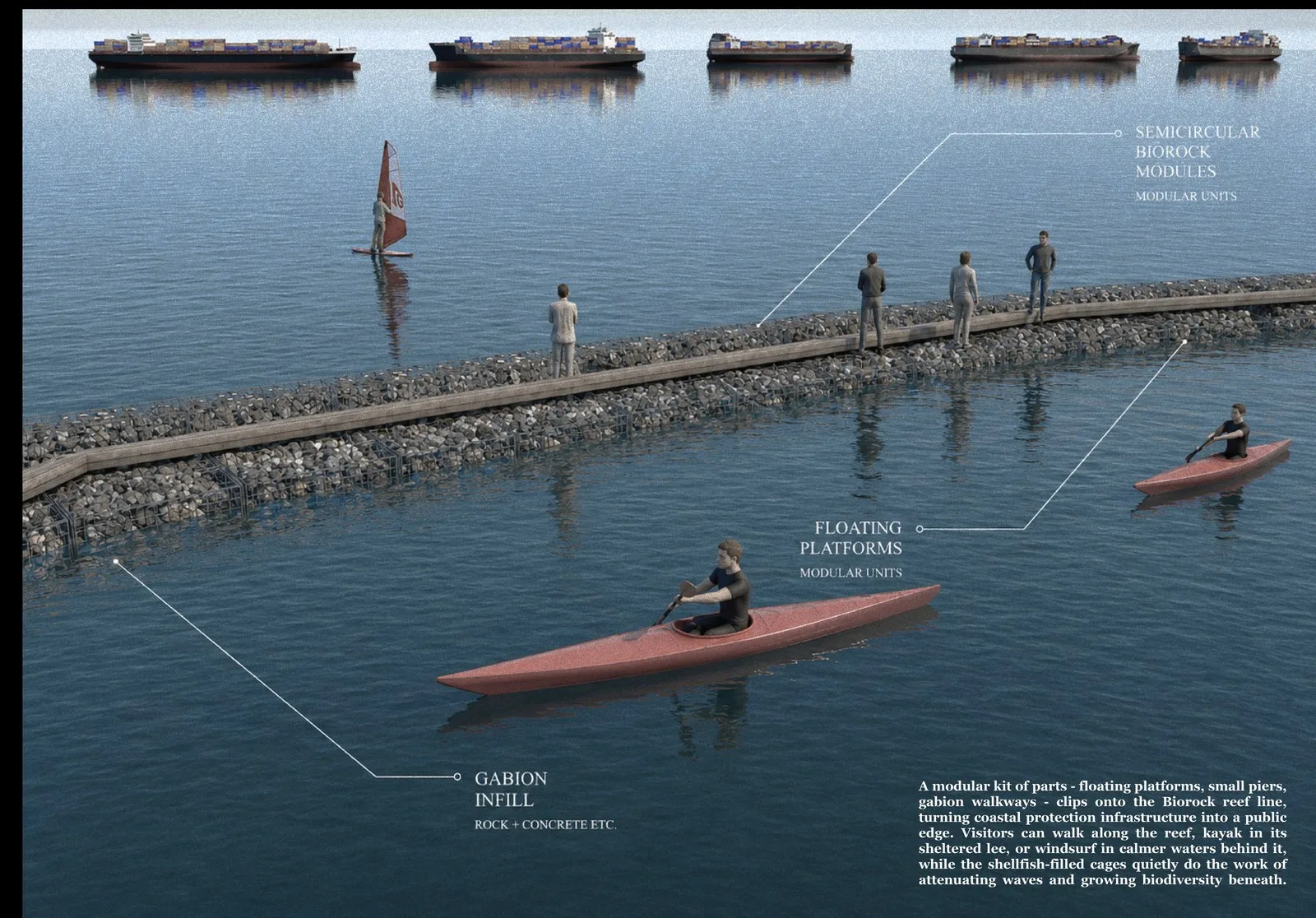
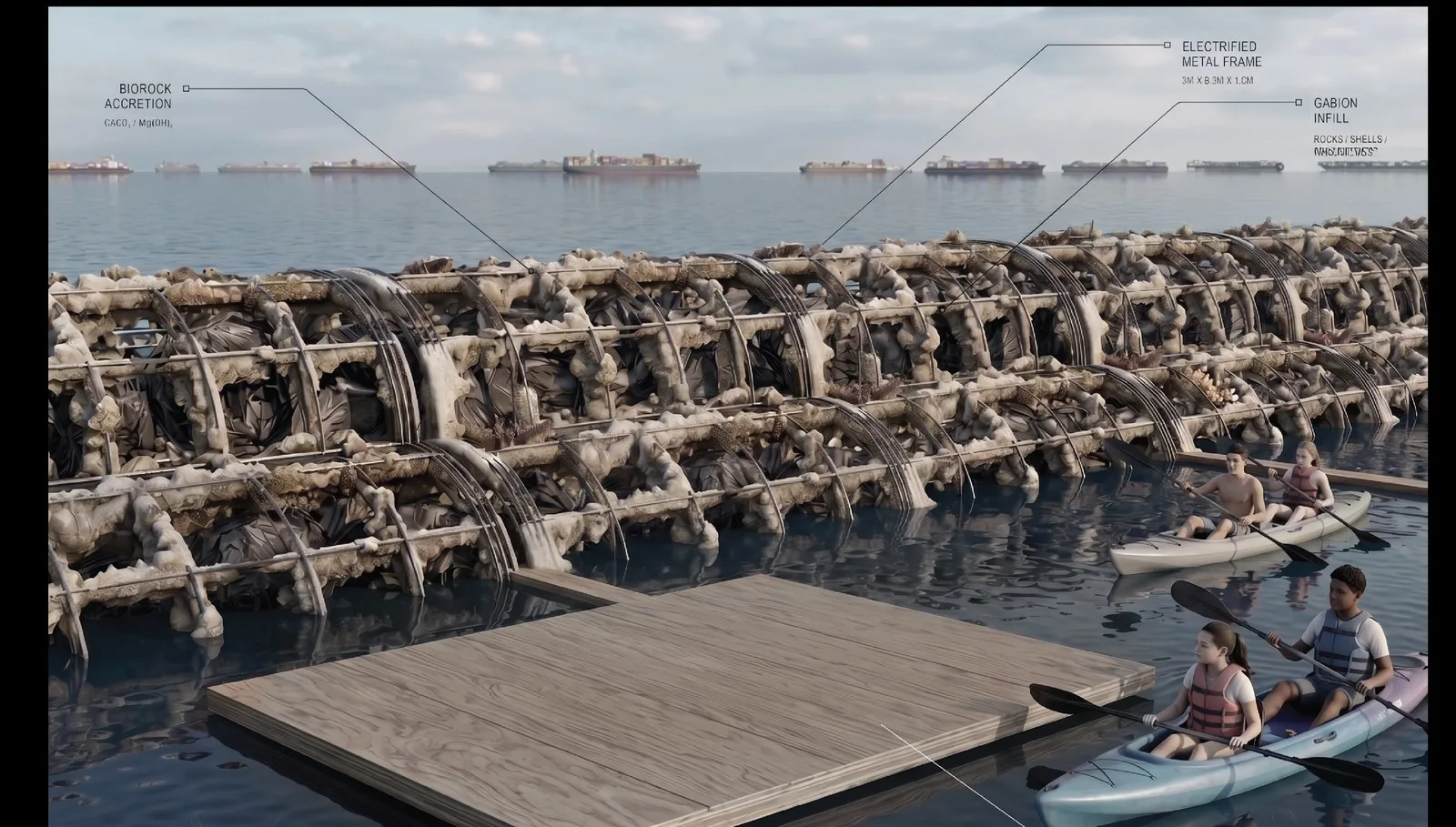
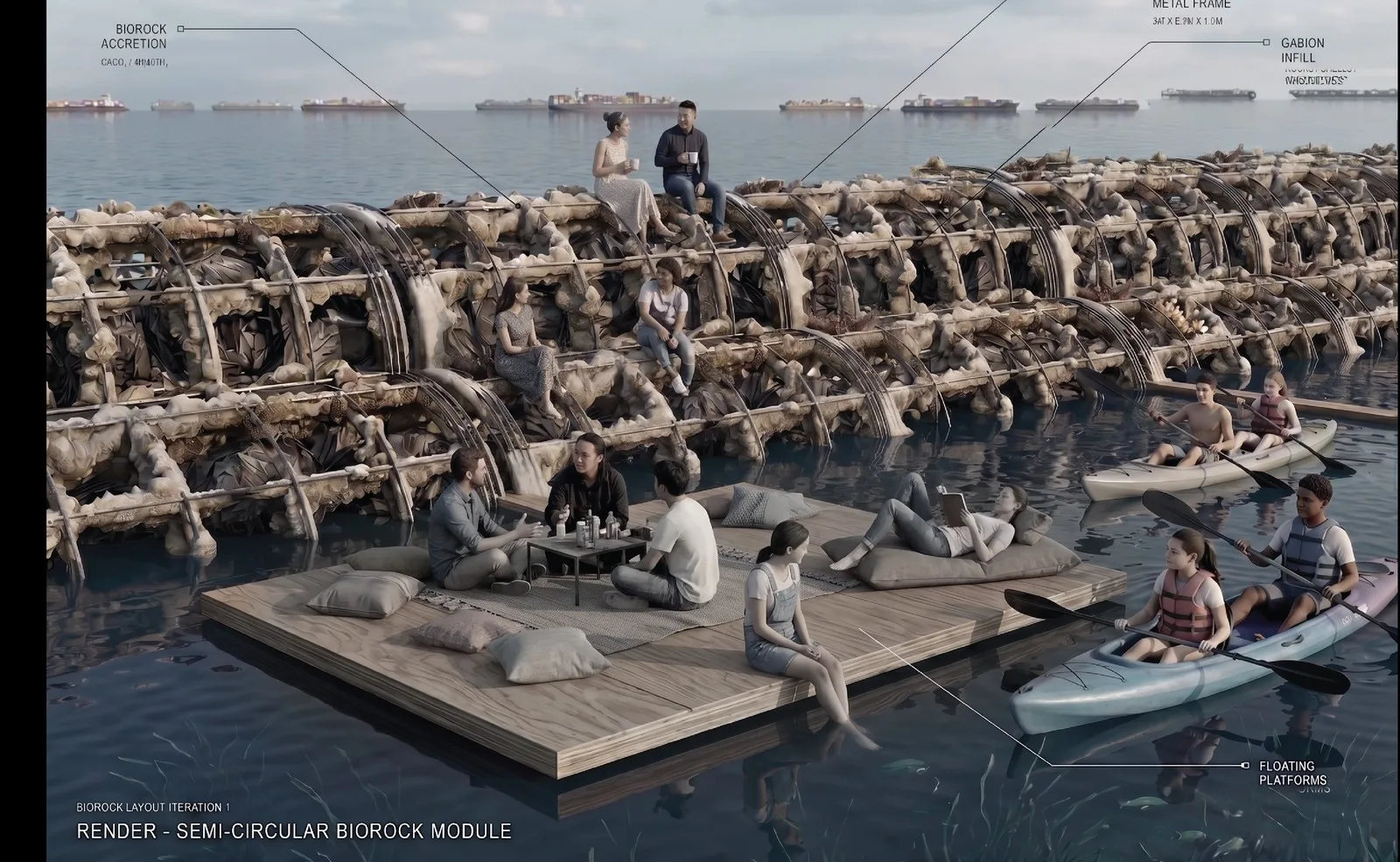
Because the geometry is modular, multifunctional attachments can be added to it: floating platforms, fish pans, small piers, floating gardens. That is the landscape urbanism argument at the heart of the project — the structure earns social grounding, fosters visual engagement with the public, and makes place rather than only defence.
A seawall asks you to stay behind it. This asks you to come and look.
Fig. 03 The breakwater as a walkable edge — a route out over the water, with the recreational life of the coast carrying on around it.Fig. 04 A floating timber platform attached to the module grid — one of the kit-of-parts components, here used as a landing for kayaks.Fig. 05 Sitting, not just passing through. The attachments are what convert a piece of coastal engineering into somewhere to spend an afternoon.Fig. 06 Low tide, reef exposed, guided observation. The same hours that grow the shellfish are the hours the public can read the structure closely.Fig. 07 Stacked semi-circular modules with a walkway over the top. The white figure gives the scale of a single unit.
Where
NSRCC beach, East Coast — assumed, not fixed.
The shoreline assumed in the proposal is NSRCC beach (National Service Resort & Country Club), East Coast, mainland Singapore. The final site is to be confirmed by PUB. Everything on this page that depends on location — orientation, wave exposure, module count — follows from that decision, and that decision has not been made yet.
What makes a site suitable
Four criteria narrow the search. They are as much about being able to learn something as about protecting a shoreline.
Criterion 01
Sandy beach or mudflat
A soft, shallow foreshore the modules can be anchored into.
Criterion 02
Real wave action
Significant wave action, with a history of erosion — otherwise there is nothing to attenuate and nothing to measure.
Criterion 03
Shellfish nearby
Natural shellfish populations close enough to supply recruitment onto the new structure.
Criterion 04
Moderate public access
People can reach it and see it, without the site being so busy that the experiment is compromised.
Site notes
The site carries coastal fauna and flora of conservation significance, including limited seagrass and coral, and it sits near a water sports recreation centre. Both facts shape the baseline surveys and the environmental impact assessment that come before anything is built.
How the work is divided
Three work packages.
Design, build, and find out. Each package has a named lead and a different discipline behind it.
WP 1
Landscape integration and conceptual reef system design
Lead · Eva Castro, SUTD
A Research by Design methodology: an iterative design loop where the reef geometry, the landscape proposition and the numbers are developed against each other rather than in sequence. Carbon calculations run alongside the design.
Wave attenuation is validated in an XBeach nearshore hydrodynamic model built by Witteveen+Bos, with a sensitivity analysis on reef orientation and location — so the design can be tested against a range of placements before anything is committed.
WP 2
Detailed reef structure and construction development
Lead · Eric Leong, Mlion Corporation
Steel cage engineering, shell cleaning and packing, fabrication and quality control, installation, and electrification. This is the package that turns a drawing into something that can be lifted onto a workboat.
Mlion aims to use recycled steel to reduce the embodied carbon of the structure.
WP 3
Monitoring and research synthesis
Lead · Jaïr Smits, SUTD
Baseline surveys and an environmental impact assessment before deployment, then monitoring for at least a year afterwards. Without this package the reef is a sculpture; with it, it is evidence.
Measurement
How we will know if it worked.
Four indicators, monitored for at least a year. Some of them are instruments in the water. One of them is asking people what they think.
Indicator 01
Hydrodynamic impact
Two wave gauges — pressure sensors — one in front of the reef and one behind it, so the difference between them is the reef's effect. An air pressure sensor supports the post-processing. Sediment dynamics are tracked with sediment traps and survey, to see whether sand is accumulating where the model says it should.
Indicator 02
Ecological function
Intertidal biodiversity surveys before deployment to set a baseline, then repeated at regular intervals afterwards. Recruitment of live shellfish onto the structure is tracked directly. Water quality is logged across six measures: pH, temperature, conductivity, dissolved oxygen, salinity and turbidity.
Indicator 03
Structural durability
Regular visual inspection for rust, breakage and failure. The Biorock coating is expected to strengthen the steel over time, but "expected" is not "observed" — so the structure gets looked at, repeatedly, by people.
Indicator 04
Public responsiveness
Qualitative interviews on how the public perceives and relates to the reef. If the landscape argument is real, it has to show up in what people say about the thing — not only in what the sensors record.
Aspirational targets
Four numbers that steer the project — and are not promises.
The proposal is explicit about this: these are aspirational targets intended to guide the project and inform decision-making, not binding commitments. They exist to give the design something to aim at and to make trade-offs discussable. Read them as direction, not as a guarantee of outcome.
10%Reduction in local wave energy and/or crest levels, against baseline.
20%Increase in native intertidal species, against baseline.
25%Lower production costs than representative coastal protection measures.
50%Reduction in carbon emissions against representative coastal protection measures.
The consortium
Who is building it.
Host
SUTD
Singapore University of Technology and Design hosts the project, through the Centre for Climate Adaptation — which operates as a multi-centre with Pratt Institute, Pace University and Aalto University.
Partner
Mlion Corporation
Partner institution. Mlion carries the engineering, fabrication and installation of the reef structure under Work Package 2.
Specialist
Witteveen+Bos SEA
Witteveen+Bos South-East Asia provides specialist services: ecological validation and hydrodynamic modelling, including the XBeach model behind the wave attenuation estimates.
Support
HSL Constructor
Construction support, and a temporary staging site for assembly and preparatory activities.
The people
Lead Principal Investigator
Prof. Eva Castro, SUTD — Professor of Practice in Landscape Urbanism and director of the Centre for Climate Adaptation at SUTD. Leads Work Package 1.
Co-Investigator
Eric Leong, founder and CEO of Mlion Corporation. Leads Work Package 2.
Co-Investigator
Jaïr Smits, SUTD. Leads Work Package 3 — baseline surveys, environmental impact assessment and monitoring.
Collaborators
Peter Frederick Ortner, SUTD (Net Zero Futures) — carbon accounting and cost-benefit. Pia Fricker, Aalto University, Academic Lead of the Centre for Climate Adaptation at Aalto — computational landscape design.
Funding
SHIELD is funded by PUB on behalf of the National Research Foundation under the Coastal Protection and Flood Management Research Programme (Living Lab), reference CFRP-LL01-0004. Grant not exceeding S$1,870,470, over the period 1 May 2026 – 30 April 2029. The project starts at Technology Readiness Level 5 and targets TRL 7.
Onward
The reef only exists if the shells do.
Every cage on this page is waiting on bags of cleaned, sun-dried shell from Singapore restaurant kitchens. That part is not engineering. That part is people.
Next
Which shells
Oysters, mussels, cockles — what we can use, what we cannot, and why the sorting matters.
If you want detail this page does not cover — a restaurant partnership, a research question, a request to visit the work — write to shellforce@cca-sg.com or sarah_tuke@sutd.edu.sg. More on the research centre behind SHIELD at cca-sg.com.